The VoiceXML Handbook: Understanding and Building the Phone-Enabled Web
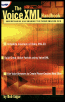
This book explains the Web, telephony, and VoiceXML, and puts them together to make your Web ring.
 TABLE OF CONTENTS
 Technology for voice recognition, (VR) otherwise known as speech-to-text, speech recognition, automatic speech recognition (ASR) or speaker independent voice recognition (SIVR) technology has been improving rapidly. Just a few years ago, a typical telephony voice recognition technology would probably have the following characteristics.
The maximum vocabulary size was typically in the range of ten to perhaps 50 words.
The recognizer would typically require that the user pause slightly between each word. There were a few exceptions: some systems would allow continuously spoken digits, for example.
The technology would typically require the system developer to collect a large number of samples of the words in the desired vocabulary. These samples would be analyzed to create a loadable vocabulary file.
Recognizers often had high error rates (mis-identified words, words not recognized) and a low tolerance for regional accents and other variations in speech (e.g., when the speaker has a cold), especially when the speaker's accent was outside the range used to create the vocabulary.
Many recognizers supported only English plus perhaps a few major European languages, such as French, German and Spanish.
Often the user would have to listen to an entire prompt before speaking, there would be no ability to interrupt a prompt byspeaking a response early. This can be frustrating, especially for experienced users.
Today's recognizers have improved dramatically and offer...