The VoiceXML Handbook: Understanding and Building the Phone-Enabled Web
This book explains the Web, telephony, and VoiceXML, and puts them together to make your Web ring.
 TABLE OF CONTENTS
 Speech synthesis, also called text-to-speech or TTS, is a technology which generates artificial speech from text.
The following sections give a brief outline of the processing stages found in a typical speech synthesizer. Details will vary substantially between synthesizers from different vendors.
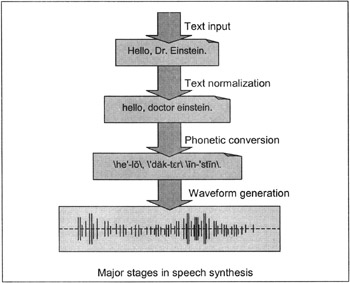
The text to be spoken is first read from a file or streaming buffer. An input rate of something like 10 bytes per second is required to give the average of about three spoken words per second or 180 words per minute which is typical for "read aloud" speech such as a radio announcer.
During the text input stage the character set of the text may be converted to the native format required by the synthesizer, whichfor modern products is usually Unicode. Unicode is a 16-bit character set which covers most of the world's major written languages and has been widely adopted by operating system and application vendors.
The text normalization process expands abbreviations and resolves other ambiguous forms.
Abbreviations are often ambiguous: for example, should "Dr." be interpreted as "Doctor" (the title for an English-speaking physician or academic), "Dronning" (the Danish title for a Queen) or "Drive" (an address)?
Numbers in particular need special attention. "1994" should be spoken as "Nineteen ninety four" if it's a year, but "one nine nine four" if it's a taxicab number, "$1994" should be spoken as "nineteen hundred ninety four dollars."
The text "1/2" might be spoken "January second" (US), "February first"...