Well Logging and Formation Evaluation
Covering all aspects of well logging and formation evaluation, this comprehensive guide offers practical techniques that will be valuable to petrophysicists and engineers in their day-to-day jobs.
 TABLE OF CONTENTS
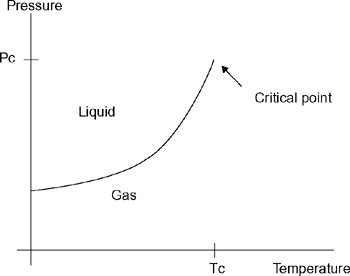
 Consider a gas for which the behavior is as shown in Figure 11.1.1. The line dividing the regions where the substance is liquid or gas is called the vapor pressure line. Hence, crossing the line from left to right, the liquid boils and becomes a gas; and in crossing from right to left, the gas condenses to form a liquid. Above the critical point (defined by P c and T c), there exists only a fluid phase with gas indistinguishable from liquid.
An equation of state relates the pressure, volume, and temperature of a substance. For gases at low pressures and medium to high temperatures, the ideal gas law may be applied:

where
| p | = | pressure in N/m 2 |
| V | = | volume in m 3 |
| n | = | number of moles |
| R | = | gas constant (8.3143 joules/Kelvin/mole or 10.732 psia.cu ft/lb mole deg R) |
| T | = | temperature in Kelvin ( C + 273). |
This equation is useful for quickly estimating how the volume of a gas might change when taken from conditions of one pressure/temperature to another. For example, say there was an influx of 1m 3 of gas into a borehole, where the pressure was 3000 psi (4.35*10 6 N/m 2) and 150 C (423K). The volume at 2500 psi/130 C could be estimated as follows:

Hence, V 2 = V 1* ( P 1* T 2 / ( P 2* T