The Wireless Internet Explained

Learn to understand technologies and standards of wireless computing as they relate to the Internet.
 TABLE OF CONTENTS
 This chapter consists of two parts. The first part looks at the types of networks that are typical of wireless scenarios. Wireless configurations are usually part of a wireline infrastructure that encompasses most of the complexity needed to serve a large area with many users. However, this dependency is not absolutely necessary. This section includes an overview of the common topologies currently in use as well as a perspective on the kinds of networking configurations that are possible within a wireless environment.
The second part of the chapter investigates some of the frameworks and layered protocols that are available to facilitate wireless applications above simply the air transmission. In the future, open mobile platforms will probably provide reliable IP-connectivity to the applications and they will do the rest. However, this is not yet the case for many wireless networks and mobile platforms. This section will look at what is currently available.
Most wireless applications do not directly work with the air interface to interact with the clients. That would be an unnecessary burden on the programmer, who is mostly concerned with the business logic of the system than with how it is delivered to the end-user.
Using the rudimentary stack suggested previously, I have expanded my wireless model to include two additional layers, as shown in Figure 4.1.
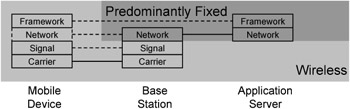
I have added Network, which connects the base station to the application server, and Framework, which can be used to abstract the...