Embedded Generation

Complete consideration of HLIII would enable the effect of generation, transmission and distribution on individual customers to be evaluated and compared against relevant design and operational criteria. Although this total effect can be monitored realistically in terms of past performance measures, it is usually impractical for future system predictions because of the enormity of the problem. Instead the predictive assessment is usually done for the distribution functional zone only. Traditionally this is acceptable because:
distribution networks generally interface with the transmission system, through which the effects of global sources of generation are seen, via one supply point. Therefore the load point indices evaluated in the HLII assessments could be used as input values for the reliability evaluation of a distribution system to give overall HLIII indices. This concept becomes less applicable with embedded generation since these generation sources are dispersed throughout the network rather than being all focused at one point (BSP)
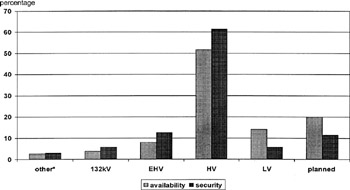
distribution systems are generally the major cause for the outages seen by individual customers and therefore dominate the overall reliability indices: generally on a worldwide consideration 80 95% of customer unavailability can be accounted for by the distribution network. Typical results are shown in Figure 7.3. These represent the UK 10 year average values [18] for availability and security (see Section 7.4.2 for definition of these terms).
*includes generation and transmission
The technical function of a distribution system is to take energy...