Embedded Generation

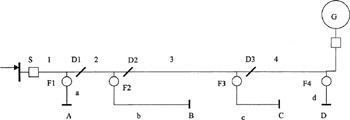
To illustrate the principles associated with the reliability assessment of distribution systems containing embedded generation, the system shown in Figure 7.5 is modified to include an embedded generation plant cited at the end of Section 7.4 as shown in Figure 7.6. Two main cases are considered: first, when the embedded generation can be operated independently of the main supply from the BSP and secondly, when it must be tripped following the failure of the supply from the BSP:
(a) Embedded generation cannot be run independently of the BSP: Consider first the situation when the embedded generation cannot be allowed to continue to operate following a disruption of supply from the BSP: this may occur due to a failure of the BSP, of the transmission system leading to the BSP, or of the distribution feeder between the BSP and the load centre being assessed. Furthermore, consider the case when the capability of the embedded generation exceeds that of the maximum demand of the system, i.e. greater than 7500kW, and is available whenever needed. The reliability results for this situation are shown in Table 7.6.
| Failure | Load point A | Load point B | Load point C | Load point D | ||||||||
|---|---|---|---|---|---|---|---|---|---|---|---|---|
| ? | r | U | ? | r | U | ? | r | U | ? | r | U | |
| Section |