Fundamentals of Optical Waveguides, Second Edition

Planar optical waveguides are the key devices to construct integrated optical circuits and semiconductor lasers. Generally, rectangular waveguides consist of a square or rectangular core surrounded by a cladding with lower refractive index than that of the core. Three-dimensional analysis is necessary to investigate the transmission characteristics of rectangular waveguides. However, rigorous three-dimensional analysis usually requires numerical calculations and does not always give a clear insight into the problem. Therefore, this chapter first describes two-dimensional slab waveguides to acquire a fundamental understanding of optical waveguides. Then several analytical approximations are presented to analyze the three-dimensional rectangular waveguides. Although these are approximate methods, the essential lightwave transmission mechanism in rectangular waveguides can be fully investigated. The rigorous treatment of three-dimensional rectangular waveguides by the finite element method will be presented in Chapter 6.
In this section, the wave analysis is described for the slab waveguide (Fig. 2.1) whose propagation characteristics have been explained [1 3]. Taking into account the fact that we treat dielectric optical waveguides, we set permittivity and permeability as ? = ? 0 n 2 and = 0 in the Maxwell s Eq. (1.17) and (1.18) as
where n is the refractive index. We are interested in plane-wave propagation in the form of
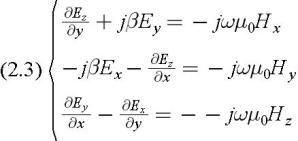
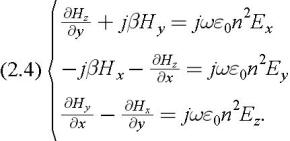
Substituting Eqs. (2.2a) and (2.2b) into Eqs. (2.1a) and (2.1b), we obtain the following set of equations for the electromagnetic field components:
In the slab waveguide, as shown in...