Fundamentals of Optical Waveguides, Second Edition

In this chapter, several important theorems and formulas [1 4] are described that are the bases for the derivation of various equations throughout the book. Gauss s theorem, Green s theorem, and Stokes theorem are foundations for electromagnetic theory. The integral theorem of Helmholtz and Kirchhoff and the Fresnel Kirchhoff diffraction formula are basic theories for solving diffraction problems.
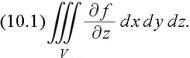
We consider the function f(x, y, z) in a volume V enclosed by a smooth surface S. Function f(x, y, z) and its derivatives ? f/ ? x, ? f/ ? y, and ? f/ ? z are assumed to be continuous in volume V and on surface S. Let us consider the volume integral of the form
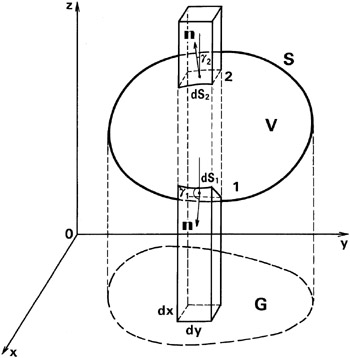
When volume V is penetrated by a column dV that is parallel to the z-axis, as shown in Fig. 10.1, we obtain
where z 1 and z 2 denote the z-axis coordinates at which column dV penetrates surface S and G is a projection of volume V onto the x y plane. Partial integration of Eq. (10.2) with respect to z gives
We express angles of unit vector n normal to the incremental surface dS 1 and dS 2 by ? 1 and ? 2.