Fundamentals of Optical Waveguides, Second Edition

Though the nonlinearity of silica-based fiber is quite small, several nonlinear optical effects manifest themselves conspicuously owing to the fact that (a) the power density is very high because light is confined into a small cross-sectional area, (b) the interaction length between the light wave and fiber material is quite long due to the low-loss property of fibers, and (c) coherent interaction is possible since the modal field distribution and polarization are well prescribed and maintained over the long length [1]. Various nonlinear optical effects in fibers will be explained, such as optical solitons, stimulated Raman scattering, stimulated Brillouin scattering, and second-harmonic generation.
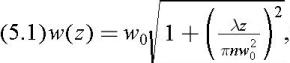
When 1 W of optical power is coupled into single-mode optical fiber with the core diameter of 10 m, the optical power density exceeds 1 MW /cm 2. Such high power density and very long interaction length are the features of nonlinear optical effects in optical fibers. The I L product, which is important to evaluate the nonlinear interactions, is defined as the product of optical intensity I( I = optical power P /effective area of the beam) and the interaction length L . In the bulk optics, when the spot size (beam radius at which an electric field becomes 1 /e) at the focal point is W 0, the beam radius w(z) at the distance z from the focal point is expressed by [2]
where ? and