3.8. RELATION BETWEEN DISPERSION AND TRANSMISSION CAPACITY
We have investigated the influence and the magnitude of several kinds of dispersion (multimode, material and waveguide) on the delay-time dispersion ? t (pulse broadening). Here let us consider the relation between the pulse broadening ?t and the transmission bandwidth of an optical fiber. When the pulse broadening of an optical fiber is ? t, the impulse response is expressed by [18]
where we assume a Gaussian-shaped optical pulse. It is readily confirmed that h(t), given by Eq. (3.204), satisfies Eq. (3.198). The baseband frequency response of an optical fiber is given by the Fourier transformation of the impulse response h(t) as
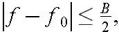
where f 0 denotes the center frequency of the signal. As described in Section 3.6.1, the NRZ signal pulse occupies the frequency range
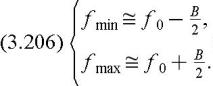
where B denotes bitrate; that is, the minimum and the maximum frequencies are given by
It is known from Eq. (3.205) that the baseband frequency response decreases as the modulation frequency f (or bitrate B) increases. We define here the maximum modulation frequency f max as the frequency which satisfies the following relation [18]:
This equation means that the baseband frequency response H(f) becomes 1 dB smaller than H(f 0 )(= 1) at f max. Combining Eqs. (3.205) (3.207), we obtain
Then the upper limit of the bitrate is given by
when the pulse broadening due to the dispersion of the fiber is ? t. We will...


 TABLE OF CONTENTS