Fundamentals of Optical Waveguides, Second Edition
3.3. OPTICAL POWER CARRIED BY EACH MODE

3.3. OPTICAL POWER CARRIED BY EACH MODE

The time averaged Poynting vector component along the z-axis per unit area is expressed, by Eq. (1.45), as


where u z is a unit vector in the z-direction. The power carried by the optical fiber is then given by


The analytical expressions for the transmission power in each mode are described in the following.

3.3.1. TE Modes

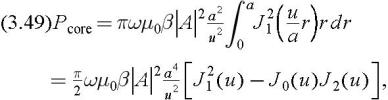
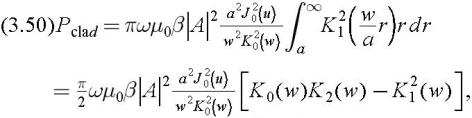
The transmission power in the core and cladding are calculated from Eqs. (3.21) (3.23) and (3.48) as follows:


where we used the integral formula of the Bessel functions


For the calculation of Eq. (3.49), we first rewrite it in the following form:


Then we substitute the dispersion equation for the TE mode (3.19) into the recurrence relation of Bessel function J 2( u) [ n = 1 in Eq. (3.42b)]:


and we also use the recurrence relation for the modified Bessel function of the second kind to obtain the expression for J 2( u):


Putting Eq. (3.55) into (3.53) and using the dispersion Eq. (3.19) again, Eq. (3.53) is reduced to


Then the optical power carried in the core and cladding regions is


The total power carried by the TE mode is given by


The unknown constant A can be determined from Eq. (3.59) when we specify the total power flow P in optical fiber. Ratios of the power confinement ratios to the total power in each core and cladding region are expressed as


3.3.2. TM Modes

UNLIMITED FREE
ACCESS
TO THE WORLD'S BEST IDEAS

SUBMIT
Already a GlobalSpec user? Log in.

This is embarrasing...

An error occurred while processing the form. Please try again in a few minutes.

Customize Your GlobalSpec Experience

Category: Specialty Optical Fiber
Finish!
Privacy Policy

This is embarrasing...

An error occurred while processing the form. Please try again in a few minutes.