Green Chemistry and Engineering

Containing expert advice from scientists around the world, this book describes both the science (theory) and engineering (application) principles of Green Chemistry that lead to the generation of less waste.
 TABLE OF CONTENTS
 Chemical reactions are diverse and are known to occur at a wide range of temperature and pressure conditions. In most reactions, the reaction vessel provides the following three components (see Fig. 5.1):
solvent,
reagent/catalysts,
energy input.
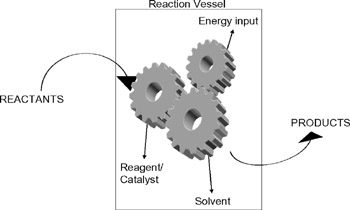
Since chemical systems are irreversible, nonequilibrium systems, they can be labeled "chaotic." Hence, they may be viewed as macroscopic analogues to the quantum uncertainties. Just as in a chaotic system, every component minor or major affects the outcome of the change or transformation, every component affects the outcome of the reaction.
Developing more benign synthetic procedures in chemical synthesis is important in moving toward sustainable technologies, as part of the rapidly emerging field of green chemistry. In reducing the amount of waste, the energy usage, and the use of volatile, toxic, and flammable solvents, several approaches are available, including avoiding the use of organic solvents for the reaction media. At the heart of green chemistry are alternative reaction media. They are the basis of many of the cleaner chemical technologies that have reached commercial development. Most well-known among these alternate reaction media being
use of safer solvents,
use of water as solvent,
reactions under solventless/solvent-free conditions,
supercritical carbon dioxide (31.1 C, 73 atm),
supercritical water (374 C, 218 atm),
room-temperature ionic liquids.
A major concern with regard to sustainability is the release of hazardous substances into the environment. Green chemistry can have a significant impact in this area. Solvents, for example, are ubiquitous in academic, industrial, and government...