Green Chemistry and Engineering

Containing expert advice from scientists around the world, this book describes both the science (theory) and engineering (application) principles of Green Chemistry that lead to the generation of less waste.
 TABLE OF CONTENTS
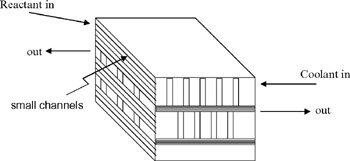
 When applied, the design philosophy known as process intensification (PI) can lead to savings in energy, to a reduction in capital expenditure, land usage, and associated chemicals, and to environmental and safety benefits. All these benefits arise due to the reduction in plant size, which is generally of the order of three or four, and reduction in mass and heat transfer resistances and reaction time, which is of the order of several hundreds (van den Berg, 2003; Akay, 2005). The concepts of PI were originally pioneered in the 1970s by Colin Ramshaw and his co-workers at ICI, and it was defined as a "reduction in plant size by at least several orders of magnitude" ( Green Chemistry, Feb. 1999, G15 G17). The "HiG concept" was invented about 25 years ago by Prof. Colin Ramshaw of ICI, while at the same time the compact heat exchanger in the form of the printed circuit/diffusion bonded unit was developed by Tony Johnstone. The latter approach is now the accepted design basis of microreactors, where the fine channels promote both rapid heat and mass transfer and give the unit a powerful multifunctional capability (see Fig. 6.1). Originally PI was developed for the bulk chemical industry, but it has been extended to value-added chemicals and pharmaceutical active ingredient manufacture (Wegeng et al., 1996; Wess et al., 2001).
The energy efficiency of a process is determined by the ability...