Green Chemistry and Engineering

Containing expert advice from scientists around the world, this book describes both the science (theory) and engineering (application) principles of Green Chemistry that lead to the generation of less waste.
 TABLE OF CONTENTS
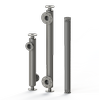
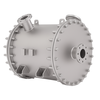
 Heat exchangers generally are based on cylindrical pipes that have a minimum surface area per unit volume through which heat is transferred (Kern, 1990). Plate heat exchangers are much more effective since they provide a higher heat transfer area. The miniaturized compact heat exchangers offer a very high heat transfer coefficient due to their small diameter and high fluid flowrates. Conventional heat exchangers suffer from fouling, leading to a decrease in the heat transfer coefficient with time. Klarex's (Netherlands) self-cleaning heat exchanger consists of a design that reduces the surface area by approximately 20% (see Fig. 6.10). The technology features a "shell and tube" heat exchanger in the vertical position. Chopped wire of the same material of construction as the heat exchanger (if the heat exchanger tubes are made of 316 stainless steel, then the chopped wire is also made of 316 stainless steel) is circulated through the unit, scouring the tubes clean. The wire exits the unit at the top and flows back to the inlet through an external downcomer. In a smaller size, this technology can be used as a reaction cum heat exchanger system as well. This self-cleaning system has been successfully used in the petrochemical, fine chemical, and pharmaceutical industries. Because these units are self-cleaning, there is no need to oversize the heat exchanger in order to compensate for fouling.

Incorporation of static mixer elements by a Spain company in the shell-tube heat exchangers has led...