Green Chemistry and Engineering

Containing expert advice from scientists around the world, this book describes both the science (theory) and engineering (application) principles of Green Chemistry that lead to the generation of less waste.
 TABLE OF CONTENTS
 PI has led to the design of a variety of new and innovative reactor designs to overcome mass and heat transfer limitations that are normally encountered in large-scale vessels (Semel, 1997). With these designs it is possible to carry out highly exothermic reactions, speed up the rate of reaction by several orders of magnitudes, totally eliminate side reactions and hence waste formation, combine reactions with unit operations, and telescope several steps into a single step.
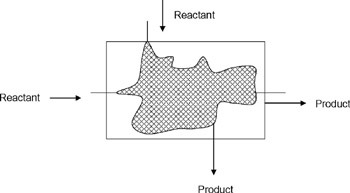
The ubiquitous batch reactor can be used to carry out polymerization reactions in the laboratory, but the recipe to be used on the plant scale has to be changed to match the relatively poor heat transfer and mixing performance of a larger-diameter vessel. Many chemical reactions are exothermic, so the rate of reaction is proportional to temperature and the reaction rate is adjusted to match the heat removal rate (Doble et al., 2004). During scale-up instead of tuning the hardware to match the process, many times the process is matched to a particular hardware. A plate reactor, a microchannel reactor (see Fig. 6.4), or a microreactor, on the other hand, has much better heat removal and much shorter residence times.
Microreactor rigs also allow for high-pressure (20 bar) operations, which can help in maintaining the reactants in liquid phase even at high temperatures (-100 C) (Skelton et al., 2001; Hessel et al., 2004). At that pressure low-boiling chemicals and solvents are maintained in liquid phase, thereby achieving...