Green Chemistry and Engineering

Containing expert advice from scientists around the world, this book describes both the science (theory) and engineering (application) principles of Green Chemistry that lead to the generation of less waste.
 TABLE OF CONTENTS
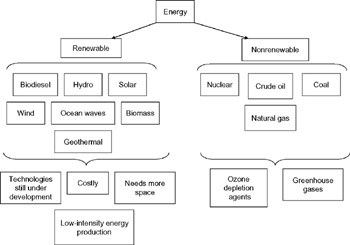
 One form of energy can be converted into another form with a certain loss of efficiency. The various forms of energy currently available and the methods to generate them appear below. Some of these energy forms are renewable, and others are nonrenewable, as outlined in Fig. 7.1. The nonrenewable energy forms have been practiced traditionally for several hundreds of years and are currently expected to disappear completely in a few hundred years or less.
Heat
by burning fossil fuels
solar radiation
warm air, water, subsurface water, and ocean
nuclear energy
earth's core (hot springs)
electricity passing through wires
Light
sun
fluorescent and incandescent lightbulbs
LED
laser
burning fuels
Electricity
photovoltaic
dynamo generators
batteries
hydrogen fuel cells
static (friction, lightning)
Radio waves
radio transmitters
Mechanical
hydroelectric facilities
Sound
vibrating surfaces (microwave)
The two most common forms of energy used by humans are heat and electricity.
When sunlight strikes the earth's surface, some of it is reflected toward space as infrared radiation (heat). Many chemical compounds found in the earth's atmosphere allow sunlight to enter the atmosphere freely, while certain gases and vapors absorb this infrared radiation and trap the heat in the atmosphere (these are known as greenhouse gases). Over a period of time, the cumulative effect of these greenhouse gases is a slow increase in the earth's surface temperature. Some of the gases found in nature, such as water vapor, carbon dioxide, methane, and nitrous oxide, and others, which are exclusively human...