Distributed Feedback Semiconductor Lasers

The group velocity is the velocity of a wave packet (i.e. the velocity of energy) that is centred on a central carrier frequency f = ?/2 ?. The group velocity is different from the phase velocity for two reasons: (i) the waveguide changes the propagation coefficient as a function of frequency; and (ii) the material permittivity changes with frequency so that the propagation coefficient in the material changes with frequency. This appendix illustrates these two roles using a symmetric three-layer waveguide so that one can appreciate the physics through putting numbers into an analytic solution.
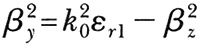
The analytic solution for the propagation coefficient as a function of frequency is well documented for the TE mode in a symmetrical three-slab guide [1 4] . The guide is illustrated in Figure 3.5, where the effect of weak transverse guiding is neglected and only the strong lateral guiding is considered. The thickness of the central layer is taken here to be d and it has a relative permittivity ? r l and is surrounded by layers with relative permittivity ? r 2. The axial-propagation coefficient ?z determines, through the wave equation with an angular frequency ?, that the central region has a lateral propagation coefficient ? y:
| (A3.1) | |
where k 0 = ? ( ? 2 ? 0 ? o) = ( ?/c) =2 ?/ ? with ? the free-space wavelength. In the outer regions there is...