Overview
This appendix gives the detailed calculations for finding the steady-state fields in a uniform DFB laser with uniform gain, and thereby finding the threshold conditions. The results are essential if one wishes to make comparisons with the numerical algorithms to estimate the accuracy of these algorithms. The appendix also provides a tutorial on the use of Pauli matrices for coupled differential equations which enables one to extend the concept of exp( ? z) to exp( M z) where M is a matrix: a useful concept for linear differential equations.
Take the coupled-wave equations
| (A6.1) | 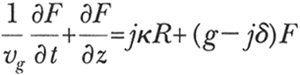 |
| (A6.2) | 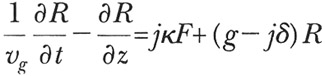 |
Pauli matrices are widely used in the quantum theory of spin and polarisation of light and the way in which the fields are coupled, but they can also be used to provide neat solutions for other physical problems (see, for example, [1]) and in particular solutions for coupled linear equations. Define then the vector F and the Pauli matrices
| (A6.3) |  |
to write eqns. A6.1 and A6.2 as
| (A6.4) |  |
If, for example, there were no gain, phase or space variations, then
| (A6.5) | 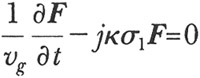 |
The reader who has not met the concept of matrix exponentials will rapidly appreciate that one may, using a Taylor series, formally write
| (A6.6) |  |
Using  (more strictly this is the identity matrix), one recovers the identity
| (A6.7) |  |
A solution then for eqn. A6.5 using Pauli matrices yields
| (A6.8) |  |
The object now is to integrate in space with a constant-frequency input with the offset frequency determined by ?


 TABLE OF CONTENTS