Distributed Feedback Semiconductor Lasers

There are three aims of this appendix:
to give a reconciliation of the classical electromagnetic-field exchange of energy and the quantum-particle exchange of energy;
to show how the rate equations derived from the particle balance are consistent with Maxwell's equations; and
to show more formally why the group velocity appears in the travelling-field equations used in Chapter 3.
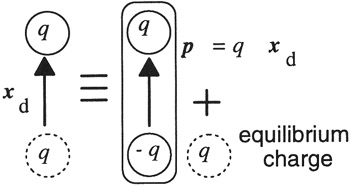
A physical model to have in mind for 'classical' laser interactions between electrons and optical fields is that displaced charges can be treated as dipoles. Figure A5.1 shows the concept of the equilibrium charge and the same charge which has been displaced by an amount x d because of the interaction with an electric field forcing the charge to move. Each displaced charge is then equivalent to a dipole being superimposed on the equilibrium charge. With a density N of charge carriers, there is then a polarisation P = qNx d, where there are two components to the displacement. The first component is dependent on the field strength E in a complex way which depends on the optical frequency and the details of the optical interaction, while the second component represents a random dipole fluctuation:
Equivalent to a dipole and equilibrium charge
| (A5.1) | |
The parameter ? is called the susceptibility with l+ ? = ? r giving the relative permittivity. In electro-optic material, it is more correctly considered as a tensor so that...