Distributed Feedback Semiconductor Lasers

The Kramers-Kr nig relationships provide fundamental rules for the relationships between the real and imaginary parts of the spectrum of any real physically realisable quantity when expressed as a complex function of frequency. One cannot, for example, design the optical gain spectrum to be any desired function of frequency without discovering that the phase spectrum is then closely prescribed. Frequently, such connections appear to be abstract and mathematically based. This appendix looks at three different ways of discovering these relationships which should help the reader to understand the fundamental nature and physics of the Kramers-Kr nig relationships. The appendix includes at the end a collection of approximations for the real refractive indices of relevant laser materials.
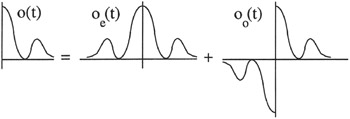
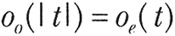
The first way relies on a real 'causal' system where no real output o( t) can occur from any system until after a real input i( t) has occurred. An elegant way to proceed splits this real output o( t) from such a system into even and odd parts, as in Figure A7.1, noting that
An impulse response over positive time = even + odd functions over all time
| (A7.1) | |
Now assume that the Fourier transform of o( t) is O r( ?) +jO i( ?) in the spectral domain so that the Fourier relationships give:
| (A7.2) | |
| (A7.3) | |
Using eqn. A7.1 links the real and imaginary parts of the spectrum [1] from