Distribution Switchgear

Covering general principles of the Switchgear function, this invaluable reference discusses topics such as interruption techniques, fault level calculations, switching transients and electrical insulation.
 TABLE OF CONTENTS
 Interruption of an alternating current arc, subtended between parted electrical contacts, will take place if the means for electrical re-ignition is removed. The gap between the contacts has to change from being an electrical conductor to being an electrical insulator at, ideally, a natural current zero.
There are a number of theories relating to the interruption of electrical current, and most of these are based upon the original theories of Cassie [1] or Slepian [2].
Cassie says:
If the energy lost from the arc column at current zero exceeds the energy input from the external electrical circuit, the electrical current will cease to flow.
Slepian says:
If, after current zero, the dielectric strength of the contact gap increases at a greater rate than the transient voltage, then the circuit breaker will clear.
Slepian's theory is illustrated in Figure 2.1.
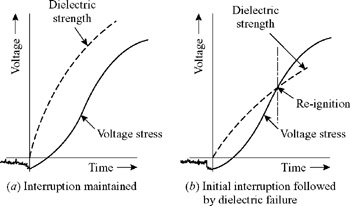
A successful interruption is shown in Figure 2.1(a) where the rate of increase of dielectric recovery exceeds the rate of increase of the transient recovery voltage stress. Figure 2.1(b) shows a failure to clear as re-ignition occurs at a point where the impressed voltage exceeds the dielectric strength of the gap.
If we put to one side fault current interruption using high-voltage fuses, interrupting mediums used in medium voltage distribution switchgear today are oil, vacuum and SF 6 gas. There is a small percentage of units based upon hard gas, where the arc is...