Distribution Switchgear

Covering general principles of the Switchgear function, this invaluable reference discusses topics such as interruption techniques, fault level calculations, switching transients and electrical insulation.
 TABLE OF CONTENTS
 The result of a fault in the electrical distribution network can be relatively minor, as shown in Figure 3.1 where a dry-type cable termination was incorrectly fitted, or it can be catastrophic, as shown in Figure 3.2. The degree of damage depends on the impedance of the circuit carrying the fault current.
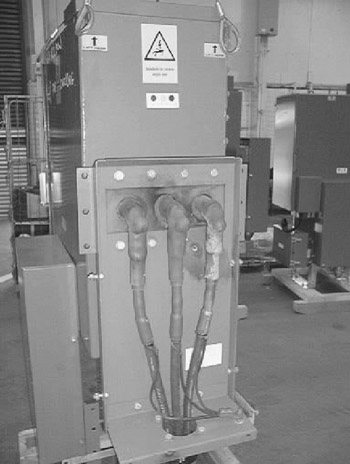

From this, it will be appreciated that when a short-circuit fault occurs in a network, such as that shown at point A in Figure 3.3, the resulting short-circuit current will only be limited by the elements of impedance that are remaining in the circuit.

At medium and high voltages these remaining elements are highly inductive, and have a much smaller value of impedance than the load that was previously being supplied. The resulting current will, therefore, be considerably higher than the full load current previously being supplied, and the power factor, considerably lower. For example, a circuit that was supplying 630 A normal current load at 0.8 power factor, could suddenly experience a current increase to 31,500 A with a power factor of 0.07 and if the short-circuit rating of the connected plant was not equal to, or higher than 31,500 A, catastrophic failure could be expected.
When planning a new installation, or modifying an existing installation by adding in a transformer or making a cable connection to another substation, the effect on the fault level...