Distribution Switchgear

Covering general principles of the Switchgear function, this invaluable reference discusses topics such as interruption techniques, fault level calculations, switching transients and electrical insulation.
 TABLE OF CONTENTS
 A circuit breaker, when it closes or opens its contacts in an electrical circuit, causes energy stored within elements of the circuit to be redistributed over a very short period of time. During this period, voltages and currents can be produced which are far in excess of those which are normally present when the circuit is experiencing steady-state conditions. The levels of transient current and/or voltage produced during disturbance of an electrical circuit are of vital interest to those who design electrical systems because, without taking preventive or protective measures, damage to the circuit elements may take place.
There are three types of circuit element that make up an electrical circuit. These are the resistance R, capacitance C and the inductance L. These are normally distributed quantities within a circuit, and in most cases can be summed for calculation purposes.
Analysis of the three elements shows that two of them, the capacitance and inductance, store energy, while the third, resistance, dissipates energy. In an alternating current circuit, the stored energy within the capacitance and inductance is given by the expressions:
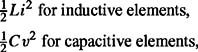
where i and v are the instantaneous values of current and voltage.
The third element within an electrical circuit is the resistance R, which dissipates energy. The value of the dissipated energy is given by the expression Ri 2.
In an alternating power system, the energy within the inductive and capacitive circuit elements is transposed between these elements as the instantaneous values...