Mark C. Morgan
Derrick Equipment Co.
Gumbo is formed in the annulus from the adherence of sticky particles to each other. It is usually a wet, sticky mass of clay, but finely ground limestone can also act as gumbo. The most common occurrence of gumbo is during drilling of recent sediments in the ocean. Enough gumbo can arrive at the surface to lift a rotary bushing from a rotary table. This sticky mass is difficult to screen. In areas where gumbo is prevalent, it should be removed before it reaches the main shale shakers.
Many gumbo removal devices are fabricated at the rig site, frequently in emergency response to a gumbo attack. These devices have many different shapes but are usually in the form of a slide at the upper end of a flowline. One of the most common designs involves a slide formed from steeply sloped rods spaced 1 to 3 inches apart and about 6 to 8 feet long. The angle of repose of cuttings is around 42 , so the slides have a slope of around 45 . Gumbo, or clay, does not stick to stainless steel very well; consequently, some of the devices are made with stainless steel rods. Drilling fluid easily passes through the relatively wide spacing in the rods, and the sticky gumbo mass slides down to disposal (Figure 6.1).
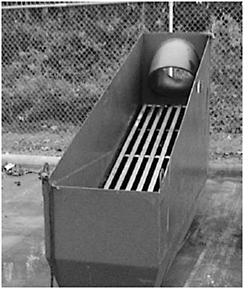 Figure 6.1: Gumbo removal device.
 Several manufacturers have now built gumbo removal devices for rig installation. One of these units consists of a series of steel...
Copyright Elsevier Inc. 2005 under license agreement with Books24x7


 TABLE OF CONTENTS