Drilling Fluids Processing Handbook

Eugene Bouse
Consulting Engineer (Drilling Fluids, Solids Control, Drilling Waste Minimization)
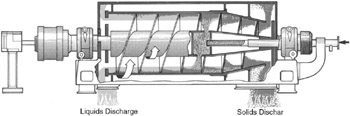
Decanting centrifuges are mechanical devices used for the separation of solids from slurries in many industrial processes. In oilwell drilling, centrifuges are used to condition drilling fluids by dividing the fluid into high-density and low-density streams, permitting one to be separated from the other. The division is achieved by accelerated sedimentation. As the drilling fluid is passed through a rapidly rotating bowl, centrifugal force moves the heavier particles to the bowl wall, where they are scraped toward the underflow (heavy slurry) discharge ports by a concentric auger, also called a scroll or conveyor, which rotates at a slightly slower rate than the bowl. The separation of the heavier particles divides the processed fluid into two streams: the heavy phase, also called the underflow or cake; and the lighter phase, which is called the overflow, light slurry, effluent, or centrate (Figure 13.1).
If time were not a factor, sedimentation could be accomplished in any container. To reduce the time required, the geometry could be manipulated to limit the depth of the fluid and, consequently, the distance the settling particles would have to traverse before reaching the bottom of the container (Figures 13.2, 13.3, and 13.4). If this approach were used, a scraping device could remove the settled solids from the bottom of the container, and one end of the container could be sloped to permit the solids to be removed from the liquid...