Drilling Fluids Processing Handbook

Chapter 9: Gas Busters, Separators, and Degassers

Bill Rehm

Drilling Consultant

9.1 INTRODUCTION: GENERAL COMMENTS ON GAS CUTTING

Solids-control equipment can be severely affected by gas in the drilling mud. This condition is misinterpreted and misunderstood in most field applications. The primary problems caused by gas cutting in solids control are blinding of the shaker screens and degradation of pump output to hydrocyclones and centrifuges. Gas cutting always occurs during drilling of a gas-bearing formation.

If there is enough gas to displace drilling fluid to the surface (and increase pit volume), bottom-hole pressure is reduced. This occurs when the pressure exerted by the drilling fluid is less than the formation pressure and there is some significant permeability. This condition requires surface control, gas busters or separators, and a degasser.

If there is no pit volume increase but the drilling fluid is gas cut and the flowline mud density reduced, bottom-hole pressure is not significantly reduced and this condition in general calls for only a degasser (see Box 9.1).

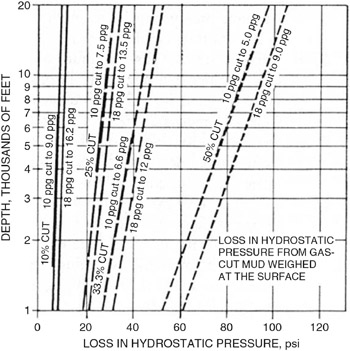
Box 9.1 Bottom-Hole Pressure Reduction Due to Gas Cutting [Goins & O Brien]

Calculation of bottom-hole pressure reduction in a static mode is expressed by the iterating Strong-White equation [Strong], a simplistic model of which is given as:


where

  • ? P = reduction in bottom-hole pressure, atm

  • n = ratio of gas to mud

  • p = hydrostatic pressure, atm

  • n = (1 x)/ x

  • x = weight of cut mud/weight of uncut mud

Or, the equation can be rearranged as:


where

  • ?

UNLIMITED FREE
ACCESS
TO THE WORLD'S BEST IDEAS

SUBMIT
Already a GlobalSpec user? Log in.

This is embarrasing...

An error occurred while processing the form. Please try again in a few minutes.

Customize Your GlobalSpec Experience

Category: Degassers (industrial)
Finish!
Privacy Policy

This is embarrasing...

An error occurred while processing the form. Please try again in a few minutes.