Drilling Fluids Processing Handbook

Todd H. Lee
National Oilwell
This chapter discusses fundamentals involved in hydraulic design, proper sizing, and operation of centrifugal pumps. It is not intended to fully educate the reader in the art of hydraulics design, but rather to give a basic understanding of hydraulic performance of a centrifugal pump. Two basic components of a centrifugal pump that are related to hydraulic performance are the impeller and casing.
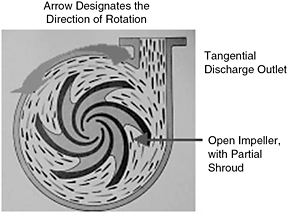
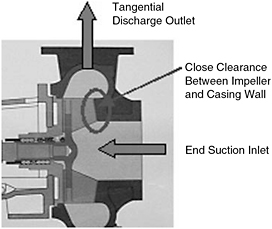
This discussion is limited to one particular type of centrifugal pump the radial flow pump. Radial flow pumps are designed to produce a flow pattern through the impeller radially outward and perpendicular to the pump shaft. This discussion is limited to a single-stage pump with an end suction and tangential discharge case design (Figures 18.1 and 18.2).
Centrifugal pumps are often referred to as kinetic energy machines. Rotation of the impeller causes fluid within the impeller to rotate at a high velocity, imparting kinetic energy to the fluid. This concept is described mathematically by the equation:
where
H i = theoretical head developed by the centrifugal pump, in ft
u 2 = rotational velocity of the impeller at the outer diameter, in ft/sec
c u 2 = rotational velocity of the fluid as it leaves the impeller, in ft/sec
g = gravitational constant, in ft/sec 2.
There are three basic impeller designs:
a closed impeller that has a shroud...