Information Visualization: Perception for Design

Chapter 1: Foundation for a Science of Data Visualization

Overview

Until recently, the term visualization meant constructing a visual image in the mind ( Shorter Oxford English Dictionary). But now it has come to mean something more like a graphical representation of data or concepts. Thus, from being an internal construct of the mind, a visualization has become an external artifact supporting decision making. The way we perceive and use external visualizations is the subject of this book.

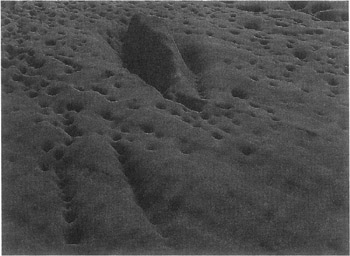
One of the greatest benefits of data visualization is the sheer quantity of information that can be rapidly interpreted if it is presented well. Figure 1.1 shows a visualization derived from a multibeam echo sounder scanning part of the Passamoquoddy Bay between Maine, in the United States, and New Brunswick, in Canada, where the tides are the highest in the world. Approximately one million measurements were made. Traditionally, this kind of data is presented in the form of a nautical chart with contours and spot soundings. However, when the data is converted to a height field, and displayed using standard computer graphics techniques, many things become visible that were previously invisible on the chart. A pattern of features called pockmarks can immediately be seen, and it is easy to see how they form lines. Also visible are various problems with the data. The linear ripples are artifacts, due to the fact that the roll of the ship that made the measurements was not properly taken into account.


Figure 1.1: Passamoquoddy Bay visualization. Data courtesy of the...

UNLIMITED FREE
ACCESS
TO THE WORLD'S BEST IDEAS

SUBMIT
Already a GlobalSpec user? Log in.

This is embarrasing...

An error occurred while processing the form. Please try again in a few minutes.

Customize Your GlobalSpec Experience

Category: Graphing and Visualization Software
Finish!
Privacy Policy

This is embarrasing...

An error occurred while processing the form. Please try again in a few minutes.