To determine a standard observer, a set of red, green, and blue lamps is used by a number of representative subjects to match all the pure colors of the spectrum. The result is called a set of color-matching functions. The set of color-matching functions for the Commission Internationale de L' clairage (CIE) standard observer are illustrated in Figure B1.1. They were obtained with red, green, and blue pure spectral hues at 700, 546, and 436 nanometers, respectively, using a number of trained observers. Notice that there are negative values in these functions. These exist for the reasons discussed in Chapter 4. It is not possible to directly match all spectral lights with these, or any other, primaries.
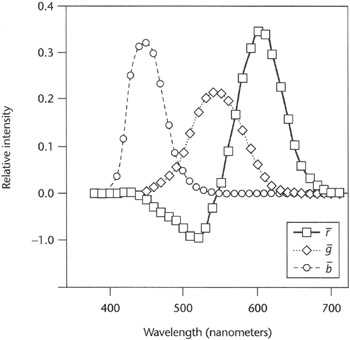 Figure B1.1: The color-matching functions that define the CIE 1931 standard observer. To obtain these, each pure spectral wavelength was matched by a mixture of three primary lights.
 For a number of reasons, the CIE chose not to use the standard-observer color-matching functions directly as the color standard, although it would have been perfectly legitimate to do so. Instead, they chose a set of abstract primaries called the XYZ tristimulus values and transformed the original color-matching functions into this new coordinate system. The process is the transformation from one coordinate system to another, as described in Appendix A. The transformed color-matching functions  ,
,  ,
,  are illustrated in Figure B1.2.
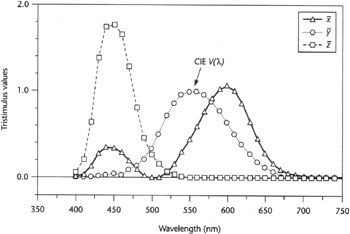 Figure B1.2: The CIE tristimulus functions used to define the color of a light in XYZ tristimulus coordinates.
 The CIE XYZ tristimulus...
Copyright Academic Press 2000 under license agreement with Books24x7


 TABLE OF CONTENTS