Information Visualization: Perception for Design

People solve problems with diagrams differently from the way they do it without diagrams. What Zhang (1997) calls external representations extend and alter the cognitive process. Visualizations function in a straightforward way as memory extensions; more important, they enable cognitive operations that would otherwise be impossible.
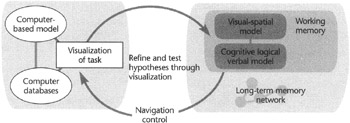
Problem solving takes place in an interactive cycle. The user builds a conceptual model of the problem and develops a problem-solving strategy that contains a visualization as a key component. The visualization feeds into and enhances the hypothesis generation and testing operations of working memory. The loop is completed as the user makes control adjustments through the visual display, to seek more information or to alter the computer-based model. Figure 10.18 illustrates this basic loop. The remainder of this chapter is devoted to showing how visualization can be an integral part of some problem-solving processes, extending memory and cognition.
To understand computer-augmented problem solving, a unified model is needed, containing both human cognitive structures and a machine-based task environment. One such unified model is the executive process interactive control (EPIC), developed by Kieras and his coworkers (Kieras and Meyer, 1997). Its major structures are illustrated in Figure 10.19. Other models have been constructed by Card et al. (1983), Anderson et al. (1997), and Strothotte and Strothotte (1997). A fully developed model of cognition is well beyond the scope of this book. The purpose...