This appendix describes the operation of transforming from one set of primaries to another. The mathematical name for this operation is a change of basis.
To convert a color from one set of primary lights to another, it is first necessary to define a conversion between the primaries themselves. We can think of this as matching each of the new primary lights using the old primary system. Suppose we designate our original set of primaries P 1, P 2, and P 3 and the new set of primaries Q 1, Q 2, and Q 3. We now use our original primaries to create matches with each of the new primaries in turn. Let us call the amount of each of the P primaries c ij.
Thus,
| (A1.1) | 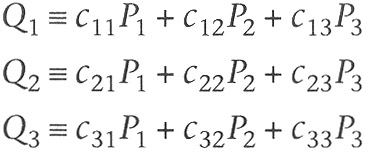 |
If we denote the matrix of c ij values C, then
| (A1.2) |  |
To reverse the transformation, invert the matrix:
| (A1.3) |  |
This same matrix can now be used to convert any set of values expressed in one set of primaries into the other set of primaries. Thus, the values p 1, p 2, and p 3 represent the amounts of the lights in primary system P needed to make a match.
| (A1.4) |  |
Then we can calculate the values in primary system Q simply by solving.
| (A1.5) |  |
Copyright Academic Press 2000 under license agreement with Books24x7


 TABLE OF CONTENTS