Information Visualization: Perception for Design

View navigation is important in visualization when the data is mapped into an extended and detailed visual space. The problem is complex, encompassing, as it does, theories of pathfinding and map use, cognitive spatial metaphors, and issues related to direct manipulation and visual feedback.
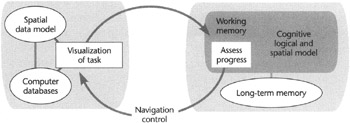
Figure 10.3 sketches the basic navigation control loop. On the human side is a cognitive logical and spatial model whereby the user understands the data space and his or her progress through it. If the data space is maintained for an extended period, parts of its spatial model may become encoded in long-term memory. On the computer side, the visualization may be updated and refined from data mapped into the spatial model.
Here we start with the problem of 3D locomotion; we next consider the problem of pathfinding, and finally move on to the more abstract problem of maintaining focus and context in more abstract data spaces.
Some data visualization environments show information in such a way that it looks like a 3D landscape, not just a flat map. This is naturally done with remote sensing data from other planets, or with maps of the ocean floor or other data related to the terrestrial environment. But the data landscape idea has also been applied to abstract data spaces such as the World Wide Web (see Figure 10.4 for an example). The idea is that we should find it easy to navigate...