Introduction to Radar Target Recognition
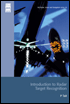
Based on the fundamental scientific principles of high resolution radar, this text covers the key techniques being developed for operational systems, and explains how they can be used in real systems.
 TABLE OF CONTENTS
 Within this section radar measurements are reviewed prior to discussing radar target recognition. The basic radar measurements have been presented in the preceding part of Chapter 2 from the point of view of detecting and tracking targets. For target recognition these same types of measurements are used, but are adapted and refined and methods for enhancing and achieving the higher resolution measurements are required.
For detecting targets, normally the highest range resolution used is much greater than the target's physical size. Typically range resolutions from tens to hundreds of metres are used in long-range air defence radars. The main criteria employed for the range resolution used for target detection and tracking are for the target's energy to be confined to one range gate and to provide sufficient range measurement accuracy for the required target tracking precision.
Similarly for the measurements in the frequency domain, the resolution required depends on the requirements for target tracking accuracy. The angular resolution requirements are dependent on the target detection and tracking accuracies needed. In contrast to detection and tracking, high-resolution radar functions are designed to divide the target into small elements, so the design criteria are very different from the conventional radar modes. However, higher-resolution modes are also governed by the basic radar range equation, but it has to be adapted. This section provides a general introduction to high-resolution measurements, which are discussed in more detail later in the context of specific high-resolution target recognition techniques.