Introduction to Radar Target Recognition

Based on the fundamental scientific principles of high resolution radar, this text covers the key techniques being developed for operational systems, and explains how they can be used in real systems.
 TABLE OF CONTENTS
 The main processes involved in the target recognition function are introduced in this section from transmitting the radar signals to providing estimates of the type of target detected, prior to more detailed discussion in the later chapters. The basic scattering mechanisms from targets are discussed, as these are the link between the electromagnetic wave illuminating the target and the physical size, shape, orientation and material composition of the target, which then result in the signature measured by the radar. The shapes of objects determine their relative rcs and the variation with aspect angle to the radar, so hence the amount of signal reflected towards and detected by the radar. For objects composed of component parts of different shapes, as is generally the case with man-made objects, each component contributes to the target signature. Also the relative contributions will vary with aspect angle to the radar. The radar cross-sections of some standard object shapes are presented.
The target recognition process is summarised in Figure 2.77.
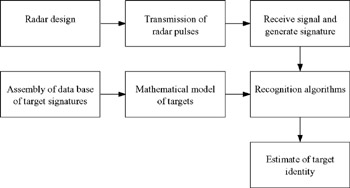
It is clearly necessary to design the radar appropriate to the type of measurement that has to be performed, to provide the type of target signature required. In order to obtain signatures of high integrity, the waveform must be carefully designed and the radar must support the transmission and reception of the signal without distortion. The waveform, the associated signal processing, radar phase noise and dynamic range...