Introduction to Radar Target Recognition
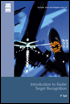
Based on the fundamental scientific principles of high resolution radar, this text covers the key techniques being developed for operational systems, and explains how they can be used in real systems.
 TABLE OF CONTENTS
 Within this chapter other high-resolution radar techniques are presented, which can either supplement the techniques discussed in the earlier chapters of the book or are particular extensions or applications of these techniques.
The super resolution techniques trade signal-to-noise ratio for resolution and can achieve much higher resolution than the limits defined by the Rayleigh criterion. Super resolution techniques are discussed in Section 6.2 and can theoretically improve any high-range resolution measurement performed using radar, providing sufficient signal-to-noise ratio is available. However, in most radar applications it is not the case, as signal-to-noise ratio tends to be a critical issue in its own right, so it is used only in particular situations. The effectiveness of super resolution techniques in radar target recognition is application-dependent and is very much under investigation, as the subject continues to develop.
Monopulse could be classed as a type of super resolution technique, which provides high cross-range resolution using a real aperture, rather than the synthetic aperture techniques previously described. It utilises a high signal-to-noise ratio to significantly improve on the cross-range resolution, which would normally be obtained at lower power signal levels using the Rayleigh criterion for determining resolution. Monopulse techniques for enhancing cross-range resolution are presented in Section 6.3.
Polarisation techniques can provide additional dimensions of data gathered using high-range and high-frequency resolution techniques. Some particular shapes of object have specific reflection characteristics, which are dependent upon the polarisation direction of the incident electric field vector. The received signals can be analysed for...