Implementing 802.11 with Microcontrollers: Wireless Networking for Embedded Systems Designers

As you continue reading further into the pages of this book you will find that I have attempted to make everything hardware and everything firmware as simple and straightforward as possible. You will not find any complex hard-to-follow C code or fancy constructs, as I am not assuming that you are a seasoned C coder. The idea here is to use HI-TECH PICC-18 C source code to convey the basic building blocks and procedures that make the PRISM-based CompactFlash radio cards work. Likewise, the EDTP-based 802.11b hardware I present will be ample for the 802.11b task but as simple as I can make it. With that, let's examine the AirDrop-P hardware in detail.
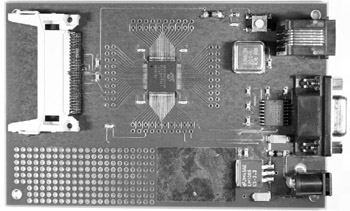
The AirDrop series of 802.11b modules started out as a universal microcontroller platform incorporating 802.11b capability that could be deployed using the 802.11b designer's microcontroller of choice. However, I couldn't see myself writing 802.11b drivers for every microcontroller that happened along. I also realized that handing you a piece of universal802.11b development hardware with no supporting 802.11b driver code examples would serve no purpose. So, instead of coding to a "virtual" microcontroller, I drove a stake into the ground and produced the AirDrop-P, which is based on the very popular Microchip PIC microcontroller. The very first AirDrop was an AirDrop-P. The original AirDrop prototype is shown in Photo 2.1.