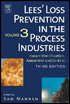
Lee's Loss Prevention in the Process Industries: Hazard Identification, Assessment and Control, Volume 3, Third Edition
At 12.37 on Saturday 9 July 1976, a bursting disc ruptured on a chemical reactor at the works of the Icmesa Chemical Company at Meda near Seveso, a town of about 17,000 inhabitants some 15 miles from Milan. A white cloud drifted from the works and material from it settled out downwind. Among the substances deposited was a very small amount of TCDD, one of the most toxic chemicals known. There followed a period of great confusion due to lack of communication between the company and the authorities and the latter s inexperience in dealing with this kind of situation. Over the next few days in the contaminated area animals died and people fell ill. A partial and belated evacuation was carried out. In the immediate aftermath there were no deaths directly attributable to TCDD, but a number of pregnant women who had been exposed had abortions.
A Parliamentary Commission of Inquiry, drawn equally from the Chamber of Deputies and the Senate and chaired by Deputy B. Orsini, was set up. The Commission s report (the Seveso Report) (Orsini, 1977, 1980) is a far-ranging inquiry not only into the disaster but also into controls over the chemical industry in Italy.
The impact of the Seveso disaster in Continental Europe has in some ways exceeded that of Flixborough and has led to much greater awareness of process industry hazards on the part of the public and demands for more effective controls.
The EC Directive on Major Accident Hazards of 1982 was a...