Lee's Loss Prevention in the Process Industries: Hazard Identification, Assessment and Control, Volume 3, Third Edition
Appendix 4: Mexico City

At about 5.35 a.m. on the morning of 19 November 1984, a major fire and a series of explosions occurred at the PEMEX LPG terminal at San Juan Ixhuatepec (San Juanico), Mexico City. Some 500 people were killed and the terminal was destroyed.

The accident was investigated by a team from TNO which visited the site about 2 weeks after the disaster and has published its findings (Pietersen, 1985). A further account has been given by Skandia International (1985).

Selected references on Mexico City are given in Table A4.1.

Table A4.1: Selected references on Mexico City

Anon. (1985v, hh); Berenblut et al. (1985); Cullen (1985); Kletz (1985p); Pietersen (1985, 1985 LPB 64, 1986a,b, 1988a); Skandia International (1985); Hagon (1986)

A4.1 The Site and the Plant

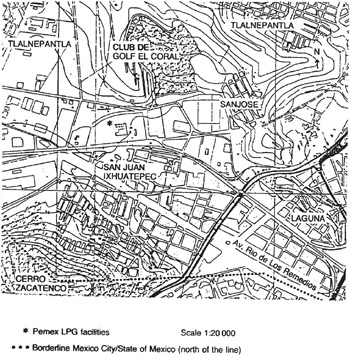
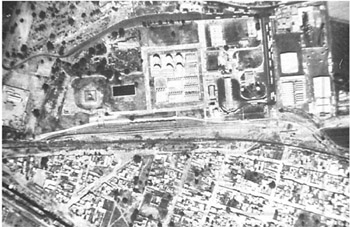
The site of the PEMEX terminal is shown in Figure A4.1 and an aerial photograph of the installation itself in Figure A4.2.


Figure A4.1: Area plan of the PEMEX site at Mexico City (Pietersen 1985) (Courtesy of TNO)

Figure A4.2: PEMEX plant at Mexico City before the accident (Skandia, 1985) (Photograph: State of Mexico)

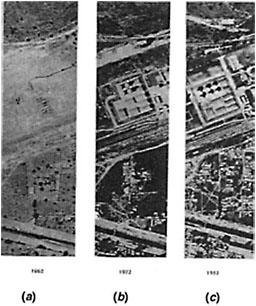
The oldest part of the plant dated from 1961 to 1962 and was thus over 20 years old. In the intervening period residential development had crept up to the site. This process of encroachment is clearly visible from the aerial photographs shown in Figure A4.3. By 1984, the housing was within 200 m of the installation with some houses within 130 m.


Figure A4.3: Growth of housing near the...

UNLIMITED FREE
ACCESS
TO THE WORLD'S BEST IDEAS

SUBMIT
Already a GlobalSpec user? Log in.

This is embarrasing...

An error occurred while processing the form. Please try again in a few minutes.

Customize Your GlobalSpec Experience

Category: Boom Lifts
Finish!
Privacy Policy

This is embarrasing...

An error occurred while processing the form. Please try again in a few minutes.