The Repair of Vehicle Bodies, Fifth Edition

Chapter 12: Gas Shielded Arc Welding

12.1 Development of Gas Shielded Arc Welding

Originally the process was evolved in America in 1940 for welding in the aircraft industry. It developed into the tungsten inert-gas shielded arc process which in turn led to shielded inert-gas metal arc welding. The latter became established in this country in 1952.

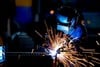
In the gas shielded arc process, heat is produced by the fusion of an electric arc maintained between the end of a metal electrode, either consumable or non-consumable, and the part to be welded, with a shield of protective gas surrounding the arc and the weld region. There are at present in use three different types of gas shielded arc welding:

Tungsten inert gas (TIG) The arc is struck by a non-consumable tungsten electrode and the metal to be welded, and filler metal is added by feeding a rod by hand into the molten pool (Figure 12.1).


Figure 12.1: TIG welding equipment AC/DC ( Murex Welding Products Ltd)

Metal inert gas (MIG) This process employs a continuous feed electrode which is melted in the intense arc heat and deposited as weld metal: hence the term consumable electrode. This process uses only inert gases, such as argon and helium, to create the shielding around the arc (Figure 12.2).


Figure 12.2: MIG welding equipment ( Migatronic Welding Equipment Ltd)

Metal active gas (MAG) This is the same as MIG except that the gases have an active effect upon the arc and are not simply an inert envelope.

UNLIMITED FREE
ACCESS
TO THE WORLD'S BEST IDEAS

SUBMIT
Already a GlobalSpec user? Log in.

This is embarrasing...

An error occurred while processing the form. Please try again in a few minutes.

Customize Your GlobalSpec Experience

Category: Welding Gases and Thermal Process Gases
Finish!
Privacy Policy

This is embarrasing...

An error occurred while processing the form. Please try again in a few minutes.