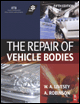
The Repair of Vehicle Bodies, Fifth Edition
Since the monocoque construction of car body-work based on engineering principles took the place of coach-built bodies mounted on a separate chassis, the whole concept of repair work has undergone radical changes in both methods and the equipment employed. Repairs to damaged body shells mean a great deal more than the beating out of a few dents, or even the cutting away of a damaged portion and welding in a new pressing.
The majority of motor cars on the road today are of unit or mono construction. Instead of a body built on to a chassis, the whole unit is constructed round a framework of light sheet metal box sections which provide an overall rigidity of exceptional strength and twist resistance. Owing to this construction, collision damage usually is confined to the area of impact; the box sections tend to crumple or concertina, thus absorbing much of the shock and rarely permitting end damage to travel beyond the centre of the car.
In order to deal with the major damage which occurs to the mono constructed vehicle, specialist equipment has been developed. The equipment consists of frame and body straighteners to pull the damaged body shell back into alignment. These are used in conjunction with body repair, alignment and measuring jigs and thus provide accurate location points where exact positioning becomes critical, especially when the panel assemblies carry major mechanical components and suspension units.
The new generation of pulling...