Automotive Control Systems: For Engine, Driveline, and Vehicle, Second Edition
Chapter 3: Engine Management Systems

3.1 Basic Engine Operation

3.1.1 Effective Work

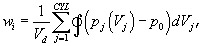
Four-stroke engines are characterized by two alternate cycles: In the first cycle, equivalent to the first and second strokes, the gas is compressed, combusted and expanded. In the second cycle, equivalent to the third and fourth strokes, the gas is transferred to the exhaust pipe and the cylinder is filled with fresh air from the intake manifold. Figure 3.1 shows the two cycles. The crankshaft is turned 360 per cycle. SI and diesel engines are controlled differently: In diesel engines, fuel is directly injected into the combustion chamber. The amount of injected fuel per stroke is then proportional to engine torque. The amount of air is almost constant at a given speed. In SI engines, the amount of fuel as well as air is controlled. When the fuel is injected into the intake manifold, a homogeneous air-fuel mixture is sucked into the cylinders. The mechanical work generated in the combustion cycle can be obtained by integration in the pV-diagram. The mechanical work can be normalized when relating it to the displacement volume V d:

(3.1)

where:

V d = CYL.( V 1 - V 2)

is the displacement volume of all cylinders

CYL

is the number of cylinders

w i

is the (normalized) indicated specific work.


Figure 3.1: pV-diagram of four-stroke combustion engine

The value of w i can be determined by measuring the in-cylinder pressure during a cycle. An indicated specific work of 1

UNLIMITED FREE
ACCESS
TO THE WORLD'S BEST IDEAS

SUBMIT
Already a GlobalSpec user? Log in.

This is embarrasing...

An error occurred while processing the form. Please try again in a few minutes.

Customize Your GlobalSpec Experience

Category: Combustion Engines
Finish!
Privacy Policy

This is embarrasing...

An error occurred while processing the form. Please try again in a few minutes.