Automotive Control Systems: For Engine, Driveline, and Vehicle, Second Edition
Chapter 5: Engine Control Systems

5.1 Lambda Control

In stoichiometric engine operation, emission levels heavily depend on how accurate the air-fuel ratio can be kept at ? = 1. Due to measurement and computational tolerances, sufficiently accurate stoichiometric operation requires a closed loop control.

5.1.1 Stoichiometric Operation of SI Engines

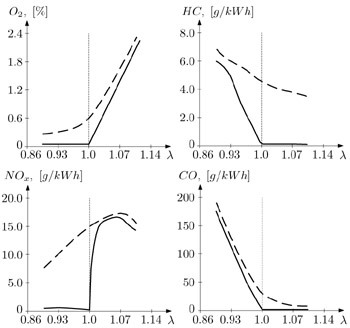
In SI engines, the air-fuel ratio ? is either very lean at part load or stoichiometric at medium and high load. A stoichiometric ratio of ? = 1 should lead to an ideal combustion. Figure 5.1 shows the emissions at different air-fuel ratios. For ? = 1, the emissions of HC, CO and NO x are relatively low. Due to turbulence and local inhomogeneity of the gas mixture, real combustion actually produces HC, CO and NO x at the same time. By means of a catalytic converter, these raw emissions can be effectively reduced.


Figure 5.1: Measurement of exhaust gases oxygen O 2, hydrocarbon HC, nitrogen oxide NO x and carbon monoxide CO. The concentration before the catalytic converter are indicated by dotted and the concentrations after the catalytic converter by straight lines.

It can be seen in Figure 5.2 that the emission rates after the catalytic converter vary highly with the air-fuel ratio ?: A change of the average ? ? = 0.1% would already double the emission rates. Therefore, it is important to have an accurate closed loop lambda control to guarantee an average air-fuel ratio within...

UNLIMITED FREE
ACCESS
TO THE WORLD'S BEST IDEAS

SUBMIT
Already a GlobalSpec user? Log in.

This is embarrasing...

An error occurred while processing the form. Please try again in a few minutes.

Customize Your GlobalSpec Experience

Category: Selective Catalytic Reduction (SCR) Systems
Finish!
Privacy Policy

This is embarrasing...

An error occurred while processing the form. Please try again in a few minutes.