Automotive Control Systems: For Engine, Driveline, and Vehicle, Second Edition
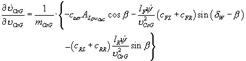
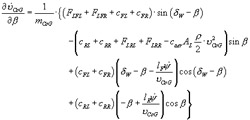
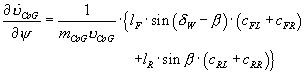
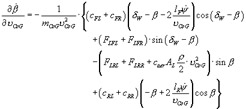
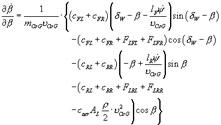
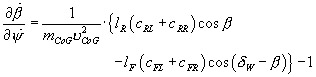
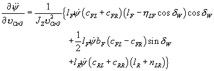
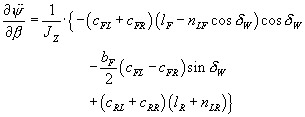
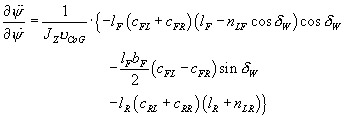
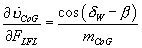
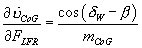
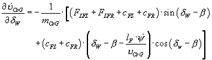
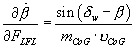
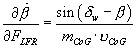
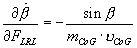
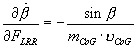
The elements of the Jacobian matrices for the nonlinear reduced 3rd order model in Section 8.4.4 are:
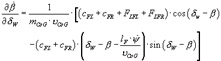
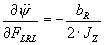
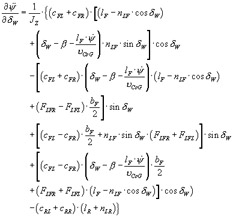
| (A.1) | |
| (A.2) | |
| (A.3) | |
| (A.4) | |
| (A.5) | |
| (A.6) | |
| (A.7) | |
| (A.8) | |
| (A.9) | |
| (A.10) | |
| (A.11) | |
| (A.12) | |
| (A.13) | |
| (A.14) | |
| (A.15) | |
| (A.16) | |
| (A.17) | |
| (A.18) | |
| (A.19) | |
| (A.20) | |
| (A.21) | |
| (A.22) | |
| (A.23) | |
| (A.24) | |
In this section, the observability of the nonlinear two-track model presented in Section 8.4.4 shall be shown.
Knowing the input u( t) of a system and measuring its output y( t), a linear system is called observable, if the initial system state x( t 0) can be reconstructed uniquely, [25].
Observability for nonlinear systems, though, is a more complex issue. For most nonlinear systems, observability can only be proved in the neighborhood of the actual point of operation (" local observability").
The proof of local observability carried out in this section is split up into two steps. Firstly, the system output y( t) is developed into a Taylor expansion with around the actual point of operation:
The function
| (A.25) | |
provides the relationship between inputs, states and outputs. The system equations are developed into a Taylor-expansion with respect to time
| (A.26) | |
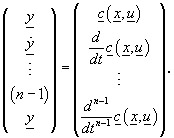
In order to describe the output of a dynamical system by means of equation A.26, the time derivatives
must be determined. Using equation A.25 this is a vector
| (A.27) | |
The first time derivative...