5.7 Transversely Isotropic Thermoelastic Materials
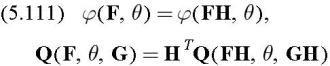
A homogeneous body is transversely isotropic, if there exists an axis of symmetry a in the reference configuration of the body such that rotations about a cannot be detected through subsequent experiments. Said differently, for a transversely isotropic thermoelastic body
for every orthogonal matrix H with a as an eigenvector. Naturally occuring materials that can be modeled as transversely isotropic include arterial walls, bamboo, and tree trunks. It can be proved (e.g., see Zheng (1993)) that  is a function of the temperature and the five invariants
and Q has the representation
with
where a bar superimposed on a quantity indicates its value for G = 0. Material parameters ? 1, ? 2, ..., ? 6 are functions of ?, I 1, I 2, ..., I 8 where
By setting N = a in Eq. (3.90), we find that I 4 equals the square of the stretch in the direction a. Substitution for into Eq. (5.24) 2 gives the following expression for the second Piola-Kirchhoff stress tensor S:
where
Let h = Fa / Fa be the unit vector in the present configuration into which a is deformed. Equation (5.116) in terms of the Cauchy stress tensor becomes
where  ,
,  , ...,
  are functions of ?, I 1, I 2, I 3, h

 TABLE OF CONTENTS