Elements of Continuum Mechanics

We now illustrate the application of equations developed in Sec. 5.17 and solve a few simple problems involving steady flow of a compressible and an incompressible fluid.
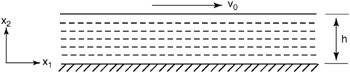
Consider the isothermal steady flow of a compressible homogeneous Navier-Stokes fluid between two horizontal parallel plates with the lower plate kept stationary and the upper one moved to the right at a uniform speed v 0. Assume that the fluid extends to infinity in the x 3-direction, it sticks to the plate surfaces, and the pressure p, the mass density ?, and the temperature ? are independent of the x 3 -coordinate. Thus we have a two-dimensional problem in the x 1 x 2-plane with the fluid flowing only in the x 1-direction, and Eq. (5.322) simplifying to the following equations.
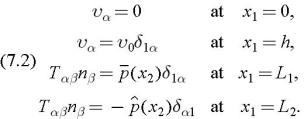
The pertinent boundary conditions are
Equations (7.2) 1 and (7.2) 2 reflect the sticking of the fluid to the two bounding plates, and Eqs. (7.2) 3 and (7.2) 4 specify pressure on the bounding planes x 1 = L 1, L 2. Boundary conditions prescribing the velocity are sometimes called essential and those prescribing surface tractions natural, e.g., see Sec. 5.4. Initial conditions are not needed for a steady flow.
We assume that b ? = g ? 2 ?, where g is a constant,...