Elements of Continuum Mechanics

A wave is regarded as a surface of discontinuity propagating in a deformable body, and the problem of finding its speed is reduced to that of solving an eigen-value problem. It is shown that for infinitesimal deformations of an unstressed homogeneous elastic body, this approach is identical to studying the propagation of plane waves. However, the former approach is applicable to nonlinear problems, but the latter is not.
Let ? be the three-dimensional region occupied by the body at time t, ? a smooth surface dividing ? into two parts R + and R ?, and n an outward unit normal to ?.
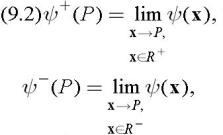
As shown in Fig. 9.1, the unit normal n points into R +. Consider a smooth function ? defined on R ? and R +. For a point P on ?, we define the jump [[ ?(P)]] in the value of ? across ? as follows:
where
That is, the jump in the value of ? at the point P on ? equals the difference in the values of ? at P as the point is approached from the regions R + and R ?. If [[ ?(P)]] = 0 everywhere on ?, then the function ? is continuous across ?; otherwise it is discontinuous, and ? is called a singular surface...