5.11 Incompressible Elastic Materials
The volume of an element of rubber, water, or air is usually changed very little when these materials undergo mechanical deformations. Neglecting the infinitesimal change in volume, they are assumed to be incompressible. Hence they can undergo only isochoric deformations. Thus constitutive relations (5.1) and (5.4) and the reduced entropy inequality (5.6) are valid for only those deformation gradients F that satisfy
Because temperature changes may induce a change in volume, for the time being, we consider isothermal deformations, i.e., the temperature of each material point is kept constant in time and the body is at a uniform temperature. Introducing a Lagrange multiplier p( X, t), the inequality (5.6) is equivalent to the requirement that
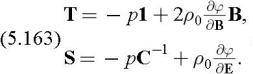
for all F. Thus
or equivalently
We emphasize that p is an arbitrary function of X and t, and is not determined by the deformation gradient F. However, it is determined by a solution of the initial-boundary-value problem, provided that tractions are prescribed on a part of the boundary of the body. The part ( ? 0 ?  / ? E ) of the stress tensor S is called the determinate part of the stress tensor S, as it can be evaluated from, the deformation gradient F.
For incompressible isotropic, transversely isotropic, and orthotropic elastic materials, constitutive relations (5.52), (5.116), and (5.134) 1, respectively, become
In writing these equations, we have substituted C 2 = I C

 TABLE OF CONTENTS