Handbook For Sound Engineers, Third Edition
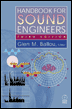
by Bill Whitlock
Many audio professionals think of system grounding as a black art. How many times have you heard someone say that a cable is "picking up" noise, presumably from the air like a radio receiver? Even equipment manufacturers often don't have a clue what's really going on when there's a problem. The most basic rules of physics are routinely overlooked, ignored, or forgotten. As a result, myth and misinformation have become epidemic! This chapter is intended to enable sound engineers to understand and either avoid or solve real world noise problems. The electronic system engineering joke "cables are sources of potential trouble connecting two other sources of potential trouble" contains more truth than humor. Because equipment ground connections have profound effects on noise coupling at signal interfaces, we must appreciate how interfaces actually work as well as when, why, and how equipment is grounded. Although the subject can't be reduced to just a few simple rules, it doesn't involve rocket science or complex math either.
For convenience in this chapter, we'll use the term noise to mean to signal artifacts which originate from sources external to the signal path. This includes hum, buzz, clicks, or pops originating from the power line and interference originating from radio frequency devices. A predictable amount of "white" noise is inherent in all electronic devices and must be expected. This random noise, heard as hiss, will also limit the usable dynamic range of any audio system, but is