Handbook For Sound Engineers, Third Edition
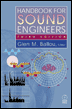
by Pat Brown
Technological advancements in the last two decades have given us a variety of useful measurement tools, and most manufacturers of these instruments provide specialized training on their use. This chapter will examine some principles of test and measurement that are common to virtually all measurement systems. If the measurer understands the principles of measurement, then many of the mainstream measurement tools will suffice for the collection and observation of data.
The most important prerequisite to performing meaningful sound system measurements is that the measurer has a solid understanding of the basics of audio and acoustics. The question "How do I perform a measurement?" can be answered much more easily than "What should I measure?" This chapter will touch on both, but the reader will find their measurements skills will relate directly to their understanding of the basic physics of sound and the factors that produce good sound quality. The whole of this book will provide much of the required information.
Sound systems must be tested to assure that all components are functioning properly. The test and measurement process can be subdivided into two major categories - electrical tests and acoustical tests. Electrical testing mainly involves voltage and impedance measurements made at component interfaces. Current can also be measured, but since the set up is inherently more complex it is usually calculated from knowledge of the voltage...