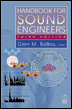
Handbook For Sound Engineers, Third Edition
Chapter 39: Digital Audio Interfacing and Networking

by Ray Rayburn

39.1 Background

In most cases it is preferred to interface digital audio devices in the digital domain, instead of using analog interconnections. This is because every time audio is transformed from analog to digital, or digital to analog, there are inevitable quality losses. While analog interfacing is simple and well understood, there are few cases in which it would be desirable to interface two digital audio devices in the analog domain. If the digital audio devices are not provided with digital audio interfaces, for example, analog interfacing will be required. Such an analog interface, however, will result in subtle changes in the digital audio from one side of the interface to the other. The exact sequence of numbers that make up the digital audio will not be reproduced at the far side of an analog interface.

The numbering system commonly used in digital audio is called binary. Each of the digits (called bits) in the binary numbering system can be either a 1 or a 0. If two binary numbers are identical, then all their bits will match.

Digital audio interfaces have the potential to allow bit accurate transfer of the digital audio from one digital audio device to another, thus ensuring no changes in the sequence of numbers that make up the digital audio, and therefore potentially perfect accuracy. In order for this potential to be realized both digital audio devices must be synchronized.

Digital audio consists of a series of consecutive numeric samples of the...

UNLIMITED FREE
ACCESS
TO THE WORLD'S BEST IDEAS

SUBMIT
Already a GlobalSpec user? Log in.

This is embarrasing...

An error occurred while processing the form. Please try again in a few minutes.

Customize Your GlobalSpec Experience

Category: Audio Analyzers
Finish!
Privacy Policy

This is embarrasing...

An error occurred while processing the form. Please try again in a few minutes.